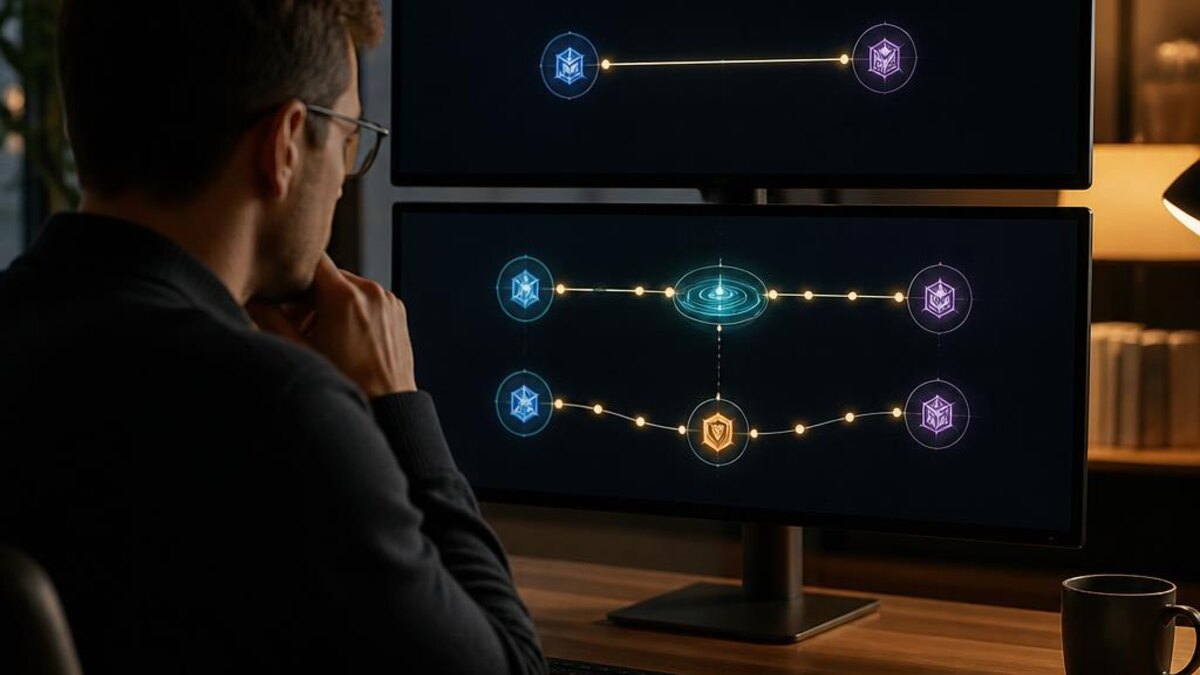
A careful decision framework built around destination, asset, route risk and information quality.
Choosing a route begins with the transfer you actually need, not a general ranking. Supported assets, direction and destination may differ even when two services use similar labels.
Define the transfer
Confirm the exact asset contract, amount, source chain, destination chain and receiving address. Check whether the destination asset is native or a wrapped representation, and whether any follow-up action is required.
Compare the route
Review the complete quote, its expiry or variability, expected execution steps and available liquidity. Separate fees from price impact. Then examine documentation for message verification, upgrade permissions and operational dependencies.
Pause when evidence is thin
If a route, token or security assumption is unclear, do not infer the answer from a ranking. Verify it in primary materials and current interfaces. BridgeFlow does not recommend a transaction route.
A five-step route review
- Identify the asset. Confirm contracts and native versus represented tokens.
- Confirm both networks. Verify the exact pair and direction.
- Read the quote. Compare sent and received amounts, gas, slippage, delivery settings and timestamp.
- Review the trust path. Check verifiers, upgrades, contracts and incident disclosure.
- Verify receipt. Follow the destination execution, not just source submission.
When routes are not comparable
Tokens, amounts, execution modes and quote times can change both cost and risk. Our overall Stargate ranking is not a personalized route recommendation.
Check the deployment list and comparison page.
Choose by the trade-off you actually face
| Your priority | What dated results show | What to check now |
|---|---|---|
| Lower total cost | Stargate: $2.84, the lowest of five | Fresh gas, amount received and supported token |
| Faster destination receipt | Across: 2m 11s, the shortest of five | Fill availability, deadline and refund conditions |
| More route options | Routing services can expose multiple paths | Underlying bridge, swaps and every approval |
| Lower operational uncertainty | No fee figure can establish safety | Exact contracts, upgrades and recovery path |
The cost and time figures above describe October 23 observations, not a forecast. Start with a small test transfer when using an unfamiliar route.
Sources for this guide
Primary references are linked for readers to check definitions, deployments and configuration. Documentation describes the protocol; it is not a live quote or an independent performance test.
- Stargate architecture and protocol overviewPool and Hydra OFT model, messaging architecture and transfer paths.
- Live Stargate asset and deployment registryCurrent chain, asset, contract and deployment records; verify a specific route here.
- Stargate integration guideIOFT interface, route quoting, Taxi and Bus transfer modes.